Loading
Case Study 02
Pre-War Apartment — Central Park West
A 5,200-square-foot pre-war on Central Park West required a full AV and automation integration, including a reference-grade screening room, under a co-op alteration agreement that prohibited any weekday work between 8am and 6pm.
- Location
- Central Park West, New York, NY
- Architect
- Withheld by request · Interior by Drake/Anderson-style practice
- Scale
- 5,200 sq ft · 9-room pre-war
- Year
- 2022 — 2023
- Status
- Occupied · under retainer
The brief
A cinema-grade room inside a century-old building.
The clients — a film-industry couple — wanted a reference-grade screening room inside a 1929 pre-war apartment. The building's alteration agreement prohibited weekday work in the 8am – 6pm window, required COI packets on every contractor, and banned pneumatic tools above the third floor. Most integrators the architect had interviewed refused to bid.
Beyond the theater, the program included whole-apartment automation, enterprise networking across 28 devices, discreet audio in every room, and circadian lighting in the primary suite. The family's two children also expected the home to stay simple enough for their nannies to operate — a constraint the clients raised on day one.
The approach
Build the theater around the building, not the other way around.
The screening room was the hardest problem. Structural isolation from the neighboring units had to be engineered before a single acoustic treatment was installed, and the processor rack had to live in a remote closet because the room's acoustic envelope could not accept fan noise. We brought in an independent acoustic engineer during the architect's design development phase, and the room was detailed as a building-within-a-building: floating floor, decoupled ceiling, double-wall construction, sealed penetrations.
All trade work was scheduled in the 6pm – 10pm window and on Sunday afternoons. Our project lead attended the building's alteration walkthroughs, served as the single point of contact for the building engineer, and produced a 180-page compliance package the co-op board's reviewing attorney called 'the most complete documentation we have ever received from an AV contractor'. We did not receive a single violation notice during the eight-month install.
The finished screening room delivers reference-grade performance without compromising the building. Ambient noise in the neighboring units, measured by the acoustic engineer after commissioning, is within one decibel of the pre-construction baseline.
A room with nothing to look at
Every acoustic treatment is also joinery.
Hover any marker to see the product, the reasoning, and the engineering that placed it there.
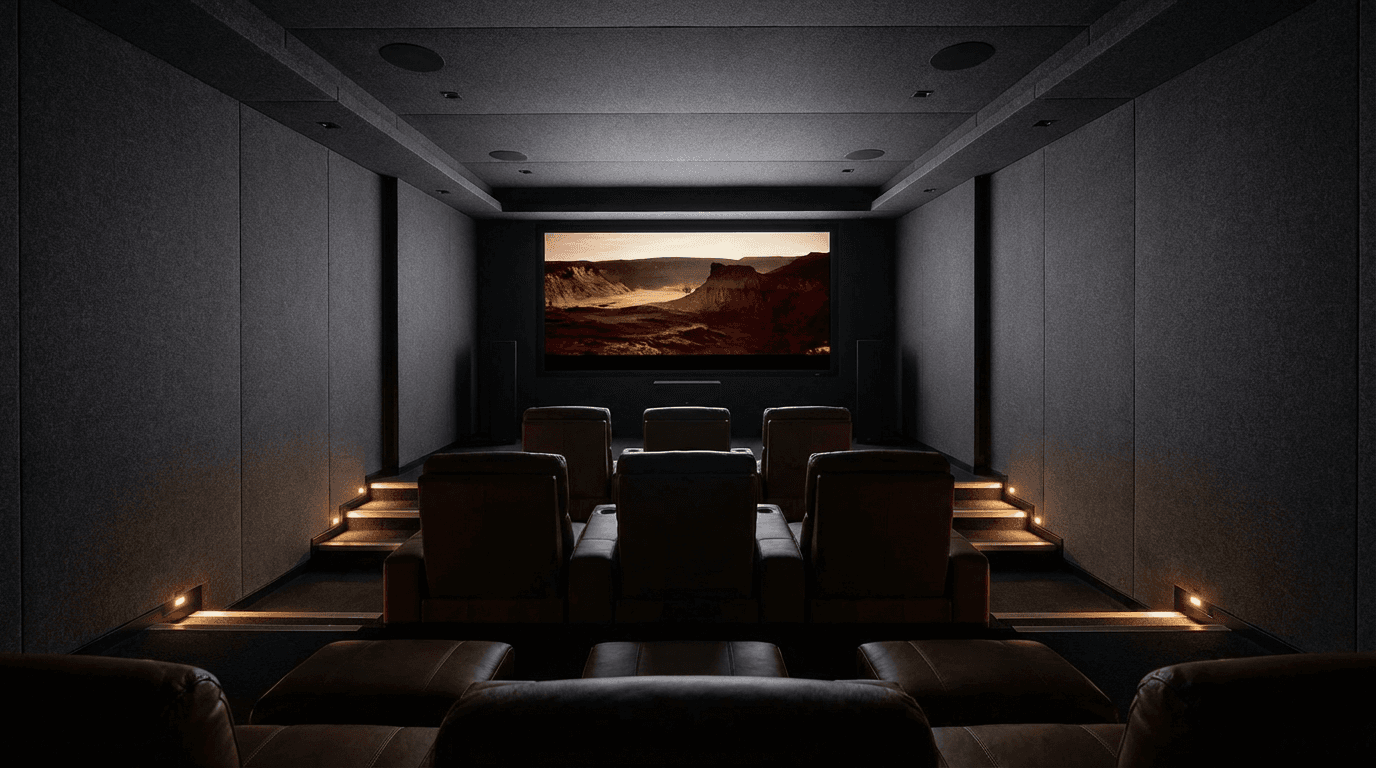
Pre-war screening room with custom built-in acoustic panels stained to match the apartment's original oak, hidden subwoofers beneath the seating, and in-ceiling Atmos speakers invisible behind perforated plaster.
The screening room delivers 83 dB reference level at the primary seat with the adjacent unit's noise floor unchanged from pre-construction measurements.
Project: Central Park West Pre-War · Architect: Withheld by request
The result
What we measured.
- 0
Alteration-agreement violations during the eight-month install.
- NC-15
Ambient noise in the finished screening room with all electronics running.
- 83 dB
Reference-level SPL at the primary seat, calibrated and verified.
- + 1 dB
Maximum noise increase in the adjacent unit, measured post-commissioning.
- 28
Devices federated on a single enterprise-grade network.
- 2 min
Operating training required by the family's nannies.
The co-op board's reviewing attorney has since referred our studio to three other projects in the building. Our alteration-agreement documentation package has become the template we issue on every subsequent Manhattan project.
“They delivered a theater that outperforms the screening rooms we use professionally — and they did it in a 1929 building without upsetting a single neighbor.”
Disciplines deployed
What this project required.
Theater
Private cinemas engineered to CEDIA RP22 standards — immersive audio, reference-grade projection, bespoke acoustic design.
Read the briefAutomation
One intuitive interface for every system in the home — lighting, climate, security, audio, video, shades.
Read the briefLighting
Tunable, circadian-aligned lighting with recessed linear fixtures that erase shadows and elevate materials.
Read the briefNetwork
Segmented, encrypted, high-density networks engineered for uninterrupted streaming, bulletproof security, and future IoT scale.
Read the briefThe MERIDIAN position
Your home is a target. We treat it like one.
The modern luxury home runs 200+ connected devices. Most are secured with nothing but the default password their vendor shipped. We take cybersecurity seriously in a way that residential integrators historically have not — and we do it as a permanent service, not a one-time install.
Read the networking briefZero-trust by default
Every device authenticated at layer 2, every traffic flow firewalled and logged. Four VLANs, no shared broadcast domain, explicit allow-list.
24/7 monitored SOC
An off-site security operations center watches your network every hour of every day. Anomaly detection, DNS reputation, real-person escalation in under 15 minutes.
Audited every quarter
Written compliance report — firmware status, traffic anomalies, capacity planning — reviewed with you every ninety days. Nothing drifts, nothing is assumed.
Next case study
ContinueMontauk Beach Compound
A 12,000-square-foot three-structure compound engineered for the Atlantic — storm-hardened, off-season-monitored, and seasonally commissioned every spring.